
Transmogrification is the final stage of Character Sovereignty. It is the moment a player ceases to be a collection of mismatched loot and begins to exist as a Visual Narrative. However, many players struggle with “Aesthetic Disconnection,” where an outfit feels “wrong” despite containing rare pieces. This analysis applies the principles of Artistic Cohesion to the dressing room, focusing on how color and shape can be manipulated to create a presence that commands attention in any capital city.
The Principle of the Silhouette
In a world of chaotic particle effects, the Silhouette is the only thing that remains recognizable at a distance. A legendary outfit must have a “Profile Priority.” For a Warrior, this might be a top-heavy, brutalist shape; for a Priest, a slender, vertical elegance.

If the silhouette is muddled by clashing armor types or oversized accessories that break the character’s form, the eye experiences Visual Fatigue. A great transmog starts with a clear shape, ensuring the character looks like a cohesive entity rather than a pile of scrap metal.
The Master’s Design Protocol
To move beyond “matching colors” and toward professional-grade character design, utilize these three core artistic pillars:
- The 60-30-10 Rule: Use a primary color for 60% of the set (usually chest/legs), a secondary color for 30% (boots/gloves/helm), and a bold accent color for the final 10% (glows/gems/weapon). This prevents Monochromatic Boredom.
- Material Consistency: Do not mix high-resolution 3D assets from modern expansions with flat, pixelated textures from 2006. This creates a “Graphical Paradox” that shatters immersion. Stick to a specific “Era” of art style.
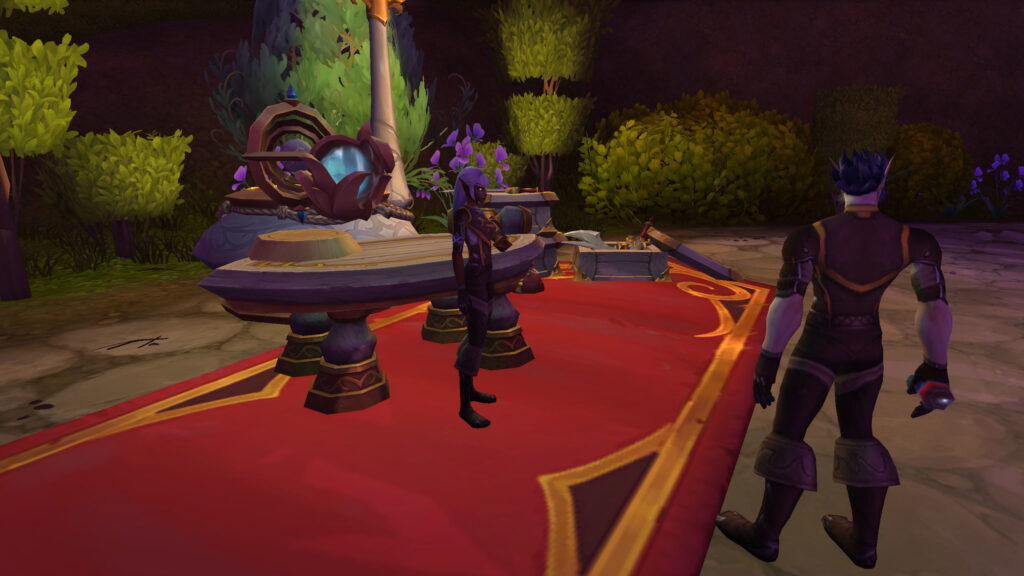
- Complementary Contrast: Use the color wheel to find balance. A deep purple robe (cool) is instantly elevated by a golden trim (warm). This creates Visual Tension that makes the outfit feel “vibrant” even in low light.
- The Weapon Anchor: The weapon is the punctuation mark of your outfit. It should either perfectly match the accent color or provide a total contrast to act as the Narrative Center of the character.
- Hidden Slot Utility: Use the “Hide” feature aggressively. Sometimes a legendary look is achieved by removing the cloak or the bracers to emphasize the Anatomical Silhouette of the race you are playing.
Overcoming Creative Overload
The Transmog tab contains thousands of items, leading to Choice Paralysis. The secret to overcoming this is to start with a “Hero Piece”—a single item you love—and build the rest of the set as a supporting cast.
This piece becomes the Aesthetic North Star. If a new item doesn’t serve the Hero Piece, it is discarded. This discipline prevents the “Clown Suit” effect and ensures every outfit you create has a singular, focused intent.
Conclusion: The Artist of Azeroth
Great transmog is not about owning the rarest items; it is about understanding how to present them. By applying basic color theory and respecting the silhouette, you transform your character into a masterpiece.
You stop being another face in the crowd and start being the hero of your own story, possessing a look that is as legendary as your achievements. Style is the only stat that never caps.